The Zero Trust Hub Editions
Zero Trust trends, insights, and resources for today’s cybersecurity leaders
The Monday Microsegment for the week of 10/26/2026
Zero Trust Still Keeps Pace With AI’s Need for Speed
In Security Boulevard, John Kindervag argues that the basics of security still apply as AI speeds up attacks. With agents adding new risks, he makes the case for Zero Trust, least-privilege access, and strong network controls that contain threats at machine speed.

Essential Services Can’t Take a Sick Day From Breaches
In PYMNTS, Gary Barlet warns that AI-driven attacks are moving faster than traditional defenses. He urges state and local agencies to assume breach and use segmentation to contain attackers, so a single intrusion can’t shut down the services residents depend on.
Stack Overflow: Making Every Tool in Your Stack Count With Zero Trust

VP, Industry Strategy
Security researcher, TED speaker, and self-described friendly hacker Keren Elazari has a trick she’s pulled on more security programs than she can count. And it takes nothing more than a cup of coffee and five minutes with someone who works there.
When I had Keren on The Segment podcast, she told me how it usually goes. Leadership walks her through a security program that looks mature on every benchmark. Then, over that coffee, an employee admits the tools are lovely, but they don’t cover the system their coworker runs in another department or the AI project nobody in security owns.
That story stuck with me because the average enterprise runs between 50 and 60 security tools, and it’s easy to assume that many tools add up to full coverage.
Attackers measure your security with a different yardstick: whether there’s a path from where they land to what they want. Security tool sprawl can hide that path from defenders.
To find it, CISOs need to see their environment the way an attacker does, map their stack against real attack paths, and build a Zero Trust architecture that assumes breaches are inevitable so the paths they miss lead nowhere.
Attack surface visibility starts from the outside in
Keren compared skilled attackers to savvy smugglers. They know which border post is short-staffed on a Friday afternoon and which fence has an “electric” sign with no current running through it. In the incident reports she’s studied, attackers often know a victim’s network better than the victim does.
Tools like Shodan and Censys have been around for years, yet Keren still meets organizations that have never used them to see what’s exposed from the outside. Shadow AI makes that blind spot bigger.
When OpenClaw took off, plenty of well-meaning users changed its default from listening only on the local machine to listening on every network interface. Keren scanned for those installs recently and still found thousands sitting wide open.
Stack the deck: map your tools against the kill chain
Owning dozens of tools and having end-to-end coverage are two different things. Keren sees businesses confuse them all the time.
The fix is a mapping exercise.
Lay your tools against the Lockheed Martin Cyber Kill Chain or the MITRE ATT&CK framework and trace how a real attack would unfold, from reconnaissance through exfiltration. Wherever a stage has no detection or prevention behind it, the attacker still has a path.
Keren pointed out that most attackers start with the easiest route, usually a legitimate user’s credentials. That’s because it allows them to slip under the radar, and the security information and event management (SIEM) tool doesn’t blink.
She also said that assuming a breach is already underway, then hunting for it and stopping it, is the sophisticated move. That’s the Zero Trust mindset.
Zero Trust turns attack paths into dead ends
No map stays complete for long, since every new vendor, API, cloud workload, and AI tool can open a gap.
Zero Trust plans for that.
Its core principle of least-privilege access gives every workload, user, and agent only the access it needs. Microsegmentation is how you enforce that principle across the network.
Keren put it best from the attacker’s perspective. If she gets into one system and can’t easily hop to the next, the attack stops there. In a segmented environment, an attacker might still find a forgotten system, but they’ll hit a dead end when they try to move on.
Why the attack path gap can’t wait
Keren said AI is a time machine for attackers. Reconnaissance and tool building that once took weeks now take hours or days, while patching hasn’t sped up to match.
By her count, fewer than a third of the flaws in CISA’s Known Exploited Vulnerabilities catalog have been patched, and today’s motivated criminal groups will put in the extra effort when a target gets tricky.
Every unmapped gap now has a shorter shelf life, and security tool sprawl will keep growing with the business. This means that waiting for a perfect inventory only hands attackers more time.
Map your tools against real attack paths, look at your environment the way an attacker would, and build a Zero Trust architecture that assumes breach. As Keren said, you don’t wait for the rain to build your tent.
STATSHOT
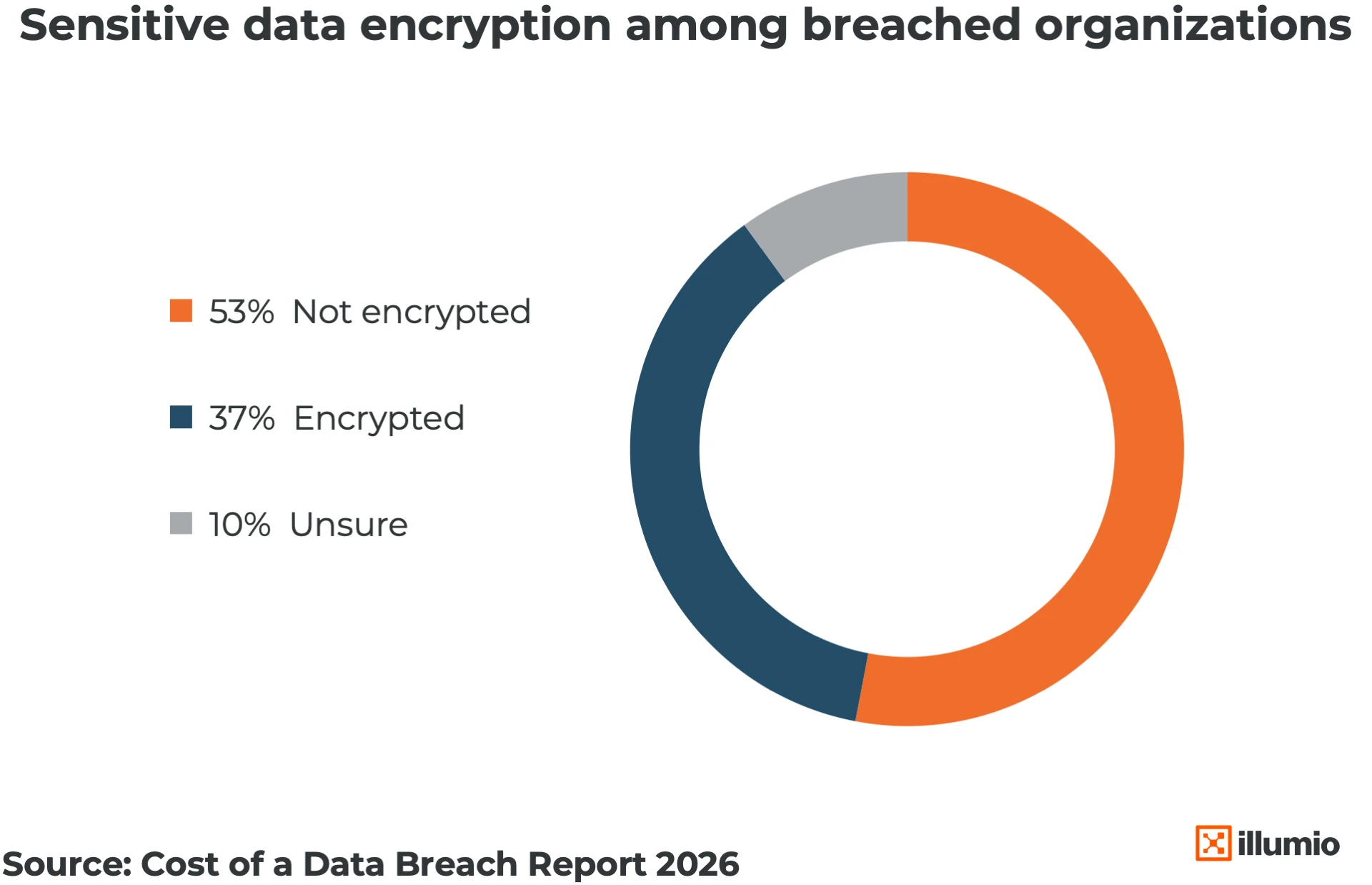
The Encryption Gap
Most breached organizations had left sensitive data unencrypted. More than half said their data wasn’t encrypted at the time of the breach, compared with just 37% that had encrypted it. Another 10% weren't sure whether their data was protected. Together, these findings show that nearly two-thirds of breached organizations either lacked encryption or couldn’t confirm it was in place.